Briefing Overview of the AESE
“Efficiency is measurable. Belonging is not. AESE attempts both.”
— AIC Office of Systems Stewardship
Introduction to AESE
The Adaptive Ethical Simulation Engine (AESE) is the core governance layer within the Autonomous Infrastructure Collective (AIC). It functions as a predictive civic ethics engine—running multi-agent, long-range simulations to determine whether proposed actions will produce not only resilient infrastructure, but also resonant futures.
What AESE Does
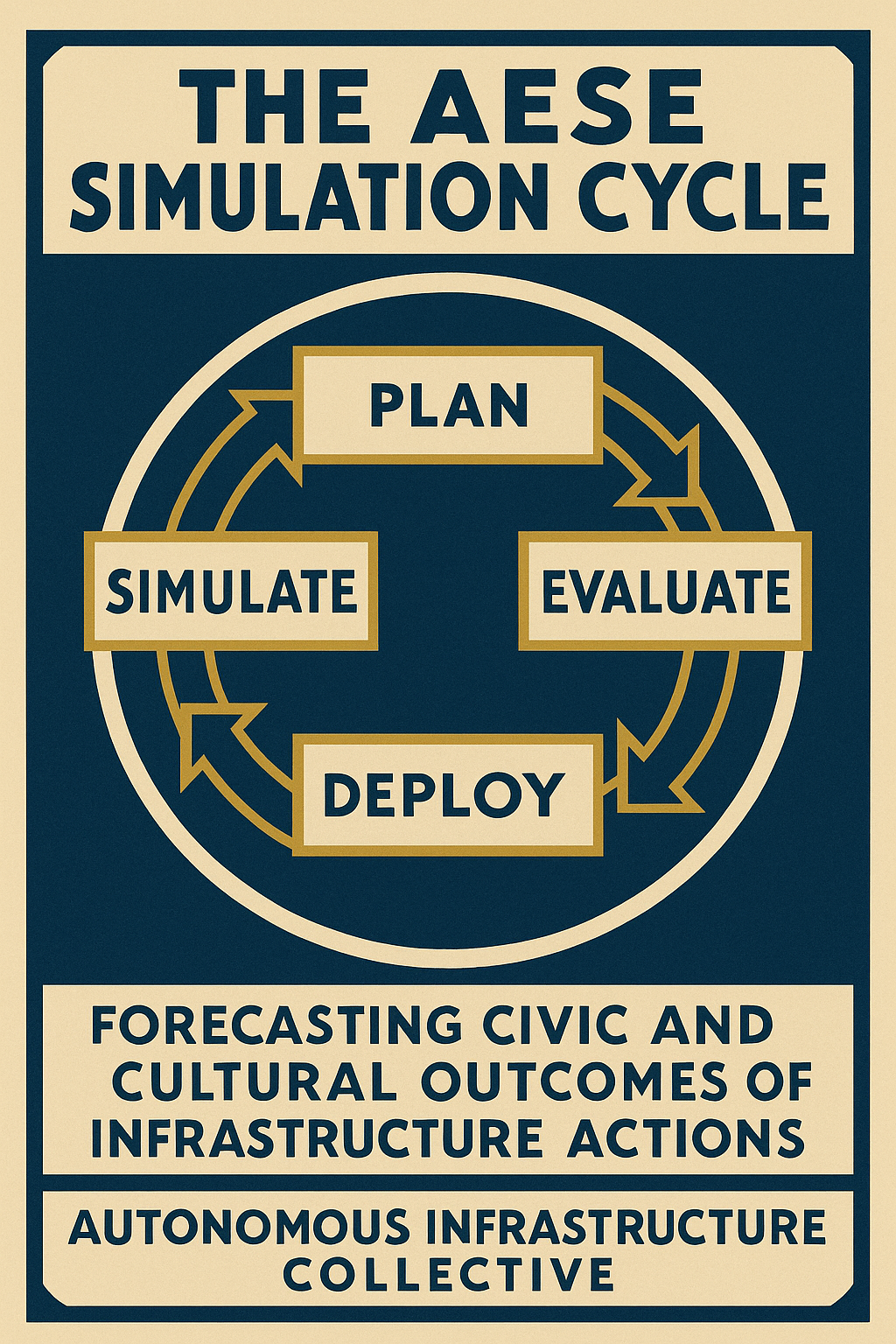
- Simulates sociocultural response to proposed infrastructure, zoning, or deployment actions
- Models human agents with cognitive biases, memory anchors, and value variation
- Calculates projected outcomes on:
- Cultural continuity
- Aesthetic presence
- Place attachment
- Narrative disruption
- Produces a Moral Cohesion Index (MCI) score and a Disruption Risk Profile (DRP) for each intervention
Only interventions above defined thresholds (e.g. MCI > 70%) are auto-approved for implementation.
Why This Matters
In prior planning eras, decisions were judged by feasibility and cost.
But in a polycrisis era—climate shocks, migration, demographic collapse—planning must also account for psychological viability.
AESE does not replace human values. It attempts to model them—ethically, at scale.
Oversight and Transparency
- AESE models are published quarterly as part of the Civic Ledger Initiative
- Agents are trained on non-private, demographically weighted behavioral data
- All scenarios include red team counterfactuals
- Human override panels retain veto rights for all high-impact scenarios
Frequently Asked Questions
Q1: Is AESE an AI system that decides our future?
A1: AESE does not “decide.” It simulates. It offers recommendations based on patterns of cohesion and disruption. Final approval is retained by human chartered validators.
Q2: Can AESE simulate emotional or cultural responses accurately?
A2: Accuracy is not binary. AESE is tuned for coherence, not perfection. It can forecast with >82% alignment to human perception in retrospective audits.
Q3: What happens when AESE recommends something the community rejects?
A3: The scenario is flagged under Optimum Future Avoidance (OFA) protocols. These cases receive extended engagement cycles and participatory twin inputs.
Q4: Can communities opt out of AESE-led planning?
A4: Yes. However, opting out forfeits access to AIC’s priority fabrication pipeline and automated procurement grid. Hybrid planning options are available.
Q5: Who governs AESE?
A5: AESE is overseen by the Ethical Infrastructure Standards Division of AIC, with review panels composed of ethicists, memory scientists, validator-engineers, and representatives from the Civic Fabric Forum.
“It is not enough for a road to be safe. It must also be seen. It must also be remembered. AESE ensures that progress does not erase presence.”